How to Choose Modern Kitchen Cupboards: The Questions That Actually Matter
Most people approach the selection of modern kitchen cupboards the wrong way round — starting with aesthetics and working backward to function. It's understandable: the visual options are abundant, genuinely interesting, and immediately engaging. The functional questions feel less urgent until you've lived in the kitchen for three months and realised the drawer you reach for a dozen times a day is positioned behind where the dishwasher door opens.
This guide inverts that approach. Seven questions, sequenced in the order they should actually be asked — each one designed to narrow the decision space before the next one opens it up.

Question One: What Does This Kitchen Need to Do Differently?
What are the three things about your current kitchen storage that create friction every day?
Write them down before you visit a showroom or browse a catalogue. Not "more storage" — that's too vague to design against. "The pots have nowhere to go except stacked," "the bin is on the other side of the kitchen from the prep area," and "we can never find the spices when we need them" are specific enough to translate into real cupboard configuration decisions.
Modern kitchen cupboards should solve real problems before they demonstrate good taste. The projects that succeed aesthetically and functionally almost always began with a clear-eyed inventory of what the previous kitchen got wrong.
Question Two: How Do You Actually Use the Space?
Is this primarily a cooking kitchen, a social kitchen, or both?
A household where one person cooks quietly most evenings has different cupboard access patterns than one where two people cook simultaneously on weekends for large groups. The first benefits from concentrated storage near the hob and prep area. The second needs counter-adjacent storage on multiple sides, accessible from different positions simultaneously. The layout follows the behaviour — not the other way around.
Modern kitchen cupboard layouts that feel uncomfortable to work in are almost always the result of planning for an idealised kitchen user rather than the actual people who will use the space. A kitchen designed around real behaviour is forgiving; one designed around an abstraction is a daily obstacle course.
Question Three: Custom, Semi-Custom, or Stock?
Does your kitchen have any non-standard dimensions, angles, or configurations?
The decision between custom, semi-custom, and stock modern kitchen cupboards should be driven by the site — not by aspiration or budget pressure alone. Kitchens with non-standard ceiling heights, angled walls, or complex appliance integration genuinely require custom manufacture to achieve a resolved finish. Kitchens with standard dimensions and simple layouts can achieve excellent results from semi-custom systems at lower cost and shorter lead times.
Question Four: Which Style Direction Will Age Well In This House?
What is the architectural language of the rest of the home?
Modern kitchen cupboards don't exist in isolation — they coexist with the home's floor plan, ceiling height, window style, and the proportions of adjacent rooms. A highly minimal handleless cupboard scheme in a Victorian terraced house creates a jarring transition that neither the kitchen nor the period architecture benefits from. A warm-toned shaker-adjacent profile with visible grain brings the two into better dialogue without requiring compromise on contemporary functionality.
The most enduring modern kitchen cupboard choices are those that are contemporary without being trend-dependent — which typically means investing in material quality and proportion rather than in the specific door profile or colour that defines a single design moment.
Question Five: What Are the Hardware Non-Negotiables?
Have you tested the hardware in person, not just seen it in images?
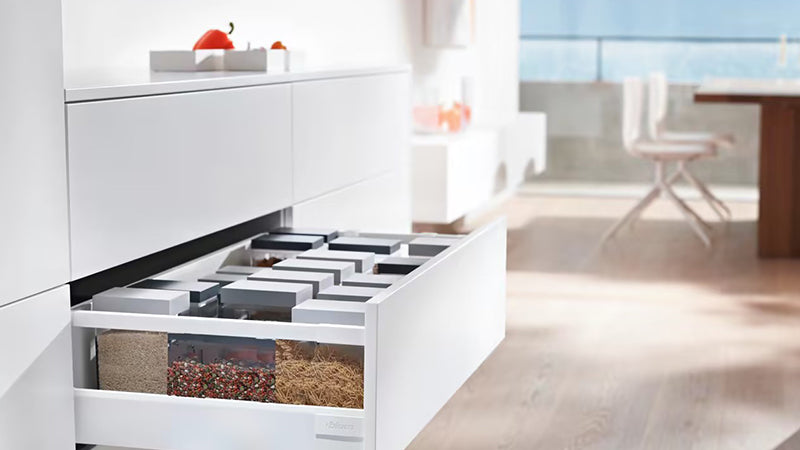
Modern kitchen cupboard hardware — hinges, drawer runners, soft-close mechanisms — is the component that determines daily experience quality. It's also the component most commonly under-specified in mid-range projects. Open a drawer in a showroom and let it fall from mid-extension: quality runners decelerate and close softly. Low-quality runners either slam or fail to fully close. This single test reveals more about build quality than any specification sheet.
Specifying by hardware brand — Blum, Hettich, or Häfele as benchmarks — protects against the substitution that sometimes occurs between quotation and installation when supply chains tighten.
Question Six: How Do You Evaluate a Supplier's Real Quality?
Can they show you a completed project from 3–5 years ago, not just their most recent work?
Modern kitchen cupboard suppliers who have been manufacturing and installing for long enough to show you how their work ages — not just how it looks on installation day — are demonstrating a confidence that newer operations cannot. Photographs of recently completed kitchens show design intent. Photographs of kitchens from several years ago show manufacturing quality.
Manufacturers with genuine longevity and an international manufacturing track record — like Goldenhome, with over 27 years of global cabinetry experience — bring a consistency of production quality and material sourcing depth that significantly affects long-term outcome. The investment in a manufacturer's reputation is part of the specification decision, not separate from it.

Question Seven: What Happens When Something Goes Wrong?
Who handles a warranty claim — and how quickly?
Modern kitchen cupboards are a long-term installation. Hardware wears, finishes develop minor imperfections, and occasionally a manufacturing fault emerges in the first year. The quality of the warranty response — how easily a claim is made, how quickly a resolution is provided, whether the installation team or the manufacturer bears responsibility — is as important as the warranty period itself. A 10-year warranty executed bureaucratically is less useful than a 5-year warranty backed by responsive service.
Before You Sign: The Consolidated Checklist
Seven Questions, Confirmed
- You've identified the specific storage problems this kitchen needs to solve
- The layout reflects how the actual household uses the space, not an idealized version
- The choice of custom, semi-custom, or stock is driven by site dimensions, not aesthetic preference
- The style direction complements the home's architectural character, not just the current trend cycle
- You've tested hardware in person and confirmed specification by brand in the quote
- You've reviewed a supplier's completed work from multiple years ago, not only recent projects
- You understand who handles warranty claims, under what conditions, and with what turnaround
Seven questions is not a long list. But these are the seven that separate kitchens homeowners describe as genuinely well-designed from the ones they'd specify differently if they could do it again. The aesthetic decisions — colour, profile, handle, finish — come after these are resolved. Not before.
A kitchen is used every day. Modern kitchen cupboards that function as well as they look — that feel as considered in year seven as they did in year one — are the product of a process that started with harder questions than "what colour should the doors be?"